All posts

Scarcity marketing is the practice of limiting how much of something is available, or for how long, so that people value it more and act sooner. It works because of a well-documented quirk in how we judge value: when something is harder to get, we assume it’s better and we worry about missing out.
This guide is for store owners. It covers what the scarcity principle is, six tactics with real examples from real brands, the point where scarcity becomes a dark pattern, and how to use it on a Shopify store without lying to anyone. It’s one chapter of our wider guide to ecommerce psychology.
What the scarcity principle is
The scarcity principle is one of Robert Cialdini’s principles of persuasion. His one-line version: people want more of those things they can have less of. His favourite example is British Airways announcing in 2003 that it would retire the Concorde. The plane hadn’t changed. Sales took off the next day because the chance to fly on it was now limited.
Boost Your Conversion Instantly with Nudgify: Turn your website visitors into customers with real-time Social Proof and FOMO Nudges. Get Started Now →
The experiment behind it is older. In 1975, Worchel, Lee and Adewole asked people to rate cookies from a jar. Cookies from a scarce jar were rated more desirable than identical cookies from a full jar. Two details matter for a store owner:
- Cookies that became scarce (the jar started full and then emptied) were rated higher than cookies that were always scarce. Watching stock disappear is more persuasive than a static “limited” label.
- Cookies that were scarce because of high demand were rated higher than cookies that were scarce by accident. “Selling fast” beats “we didn’t order many”.
That second finding is why scarcity and social proof are usually shown together: a low stock count is more convincing when the visitor can see other people buying.
Scarcity is a close sibling of urgency. Urgency limits time (the sale ends Friday). Scarcity limits quantity or access (three left, members only). Most campaigns use both. We cover the time side in our guide to limited time offers; this page focuses on quantity and access.
Six scarcity marketing tactics, with real examples
1. Limited stock
The most common form in ecommerce: show the visitor how many units are left. A falling number is exactly the “became scarce” condition from the cookie study.
Example: Booking.com. Hotel booking sites made “only 1 room left on our site” a household phrase. It worked so well it attracted regulators. In February 2019 the UK Competition and Markets Authority secured commitments from Expedia, Booking.com, Agoda, Hotels.com, ebookers and trivago to stop “giving a false impression of the availability or popularity of a hotel”. That September, Which? checked ten “only X rooms left” claims on Booking.com and found five didn’t match availability. At one London hotel the site showed one room left; 34 were bookable on the next page.
Increase Trust & Sales with Social Proof
Boost trust, engagement, and conversions with Social Proof — tailored for any industry and easy to integrate. Seamlessly manage client access with our team portal.

At scale. A 2019 Princeton study (Mathur et al.) crawled around 11,000 shopping sites and found 632 low-stock messages. Seventeen were provably fake: 16 sites counted stock down on a fixed schedule and one generated a random number on every page load. Eight used off-the-shelf Shopify plugins to do it.
2. Limited time
The product isn’t limited; the window to buy it at this price is.
Example: Amazon Prime Day. Prime Day 2025 ran from July 8 to July 11, a hard 96-hour window. Inside it, Amazon layered a second deadline: “Today’s Big Deals” launched at midnight Pacific each day and ran “for a limited time, while supplies last”. Two clocks, one event.
Countdown timers are the most abused version of this tactic. The Princeton study found 393 countdown timers and judged 157 deceptive: the timer reset with the offer still live, or expired with the offer still live. One example was a 60-minute timer on justfab.com whose offer was still valid after it hit zero. The FTC’s 2022 report Bringing Dark Patterns to Light names “countdown timers designed to make consumers believe they only have a limited time” when the offer isn’t time-limited. If you use a timer, it has to end something.
3. Limited edition
A fixed production run. Once it’s gone, it’s gone, and everyone knows that going in.
Example: e.l.f. Cosmetics x Liquid Death. Their 2024 “Corpse Paint” collection sold out in 45 minutes, a figure e.l.f. put in its own press release announcing the follow-up: Lip Embalms in miniature Liquid Death cans, on sale January 14, 2026 “in limited quantities”. The first sell-out became the marketing for the second drop.
Example: Supreme. Supreme is credited with inventing the retail “drop”: small groups of products released every Thursday rather than a full season at once. There’s never a moment when everything is available.
Limited editions are the safest form of scarcity because the limit is a decision made before launch, not a message added after. They also make honesty easy: you can say how many you made.
4. Waitlists, draws and reservations
When you can’t, or don’t want to, sell to everyone at once, make people queue. A queue is proof of demand, and demand-driven scarcity is the kind the cookie study found most persuasive.
Example: Nike SNKRS Draw. For limited-edition shoes, Nike doesn’t sell first-come-first-served. Members enter a Draw during a window (“the product page will display a countdown clock to show how much time is left”), pick a size they can’t change, and hear within 24 hours whether they were selected. “You’ll only be charged if you are selected.” Scarcity, urgency and membership in one flow.
Example: Tesla Cybertruck. Tesla opened reservations the night it unveiled the Cybertruck in November 2019, for a $100 deposit. Elon Musk posted “146k Cybertruck orders so far” the next day. The reservation count became the story.
5. Seasonal drops
Something that returns on a schedule, then leaves. The scarcity is predictable, which is the point: people learn to wait for it.
Example: Starbucks Pumpkin Spice Latte. Starbucks announced on July 21, 2025 that the PSL would return on August 26. The drink has come back every autumn for more than 20 years, and the return date is announced like a product launch, a month ahead, every year.
Example: McDonald’s McRib. McDonald’s brought the McRib back to participating US restaurants on December 3, 2024, “for a limited time”, after it had been off menus since 2022. The farewell and the comeback are both marketing events. The sandwich never changes.
For a store, this can be a product only sold in Q4, or a summer-only colourway. It has to actually leave when you say it will.
6. Member-only access
Scarcity of access rather than product. The item exists in quantity, but only certain people can buy it.
Example: Amazon Prime Day. Amazon’s own FAQ for 2025 is blunt: “Yes, you will need a Prime membership to shop all the deals coming to Amazon during Prime Day.” The whole event is a reason to join.
Example: Nike Members. The SNKRS Draw has one entry requirement: “You just need to be a Nike Member.” Free to join, but you have to join, and that’s an email address Nike now owns.
Member-only works for small stores because the membership can be free. “Members get early access to the drop” costs nothing and builds the list you’ll use for the next one.
When scarcity backfires
Scarcity stops working the moment the customer reads it as a tactic rather than a fact.
A 2014 study by Lee, Oh and Jung found that when people had the bandwidth to think about why a marketer was making a scarcity claim, “they were more likely to perceive scarcity as a sales tactic”, and the claim stopped helping the product. Company reputation changed how readily people made that inference. A brand people trust gets the benefit of the doubt on “only 3 left”; a brand they don’t gets the opposite.
Four things reliably trigger the “it’s a tactic” reading:
- Scarcity on everything. The Princeton study noted sites like 6pm.com showing “Only X left” on nearly every product. When everything is scarce, nothing is.
- Scarcity that doesn’t resolve. A timer that resets. A “last one” that’s still there next week.
- Scarcity that contradicts itself. Booking.com’s “1 room left” next to a booking page showing 34 rooms.
- Scarcity with no reason. “Hurry, limited stock” on a mass-produced t-shirt. The cookie study showed scarcity needs a cause, and high demand is the cause that works.
False scarcity is a dark pattern, and increasingly a legal problem
Fake scarcity is the same family as fake social proof: invented numbers dressed up as customer behaviour. Regulators treat it the same way.
- In the UK, the Digital Markets, Competition and Consumers Act 2024 lists “falsely stating that a product will only be available for a limited time” as a practice that is unfair in all circumstances (Schedule 20, item 7). No case-by-case test; it’s simply banned.
- In the US, the FTC’s 2022 dark patterns report names fake countdown timers specifically.
- The CMA’s 2019 action on hotel booking sites covered both false availability claims and placing sold-out hotels in search results to pressure people into booking faster.
The tooling has moved too. Hurrify, a Shopify app whose “Evergreen” default restarted the countdown every time it hit zero, was reported by dark patterns researcher Harry Brignull in early 2023 and later removed from the Shopify App Store. If you install a scarcity app, read how it gets its numbers before you read anything else.
How to use scarcity honestly on a Shopify store
Honest scarcity has one rule: every number and every deadline must come from something real.
Show real stock levels from your inventory
Shopify tracks quantity once you turn on inventory tracking, and the free Dawn theme has an “Inventory status” block you can add to the product page in the theme editor. It has a “Low inventory threshold” setting (default 10, range 0 to 100) and an “Inventory count” checkbox. Above the threshold it says “In stock”; at or below, “Low stock: 3 left”; at zero, “Out of stock”. The number comes straight from your inventory, so it can’t lie.
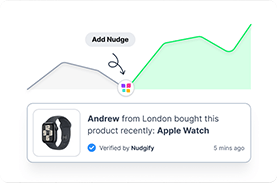
If you want the message to stand out more than a theme block, or your theme doesn’t have one, Nudgify’s Low Stock Nudge does the same job as a notification on the product page. It reads live stock from your store, shows the product image, and changes wording as the count drops: “More than 5 in stock”, then “Only 5 left in stock”, then “Hurry up! Only 3 left in stock!”. At zero it doesn’t show at all, and you can hide it until stock falls to five or fewer. All that logic exists so it never shows a number you didn’t have.
Make limits real before you announce them
- Limited edition: decide the run size, and consider stating it (“500 made”). Don’t restock under the same name.
- Limited time: give the discount an end date in Shopify, so the offer ends when the banner says it does. Set any timer to the same date. One deadline, enforced by the system, not the copy.
- Seasonal: unpublish the product when the season ends. If it’s still buyable in February, it isn’t a summer exclusive.
- Member-only: use early access for your email list or customer accounts. Free membership is fine; what matters is that non-members genuinely can’t buy during the window.
Use scarcity where it’s true, not everywhere
Put low-stock messages on products that are actually low. Put countdowns on offers that actually end. Leave the rest alone. The Princeton researchers flagged 6pm.com not because its numbers were fake, but because “Only X left” appeared on nearly every product, which makes real scarcity invisible when it happens.
Pair it with real demand
Worchel’s cookies were most desirable when they were scarce because other people wanted them. On a store, that means showing low stock next to genuine recent activity: real orders, real add-to-carts. The stock number says “not many left”; the activity says “and here’s why”. Both have to be real or neither works.
Scarcity marketing FAQ
What is the scarcity principle in marketing?
The scarcity principle says people place more value on things that are limited in quantity, time or access. Marketers use it by showing low stock, setting deadlines, making limited runs, or restricting who can buy. It’s one of Cialdini’s principles of persuasion and was demonstrated experimentally in 1975.
Is fake scarcity illegal?
Increasingly, yes. In the UK, falsely stating that a product is only available for a limited time is a banned practice under the Digital Markets, Competition and Consumers Act 2024. In the US the FTC treats fake countdown timers as a dark pattern. Even where it isn’t illegal, it’s the fastest way to make customers stop believing anything on your site.
How do I show low stock on Shopify?
Turn on inventory tracking for the product, then add the “Inventory status” block to your product page in the theme editor (Shopify’s Dawn theme has it built in, with a low-stock threshold setting). For a more visible notification that reads the same live stock data, use a low stock nudge on the product page.
Does scarcity marketing work for small stores?
Yes, and it’s often easier to do honestly at small scale, because your limits are real: you genuinely have 40 units, your drop genuinely is 200 pieces. The mistake small stores make is copying big-brand scarcity theatre without the inventory or demand behind it. Start with real stock counts and a real end date on your next sale.