All posts

Every example below was pulled from a live page on 16 October 2026. Each one is named, linked, and quoted as it appeared that day, so you can go and look at it yourself. Numbers change, so treat them as a snapshot.
This page is a gallery of formats. If you want the strategy behind them, read how to use social proof in marketing. If you want placement advice for a specific page type, read social proof on landing pages. And if you want the psychology underneath all of it, the ecommerce psychology guide covers scarcity, urgency and consensus with the original studies.
Quick definition first. Social proof is the tendency to copy what other people do when we’re unsure what to do ourselves. On a website, that means any signal that other people bought, used, rated or endorsed the thing in front of you. The formats below are the ways real companies turn that signal into something a visitor can see in two seconds.
Boost Your Conversion Instantly with Nudgify: Turn your website visitors into customers with real-time Social Proof and FOMO Nudges. Get Started Now →
For each example you get three things: what it is, why it works, and how a small store can copy it without a big budget.
Reviews and ratings
1. Brooklinen: a review count in the hero
What it is. The Brooklinen homepage puts “175k+ 5-Star Reviews” in the top strip, then follows up lower down with “Rated 5 stars out of 5 by over 100,000 customers” and a single quoted review (“Literally the best sleep I’ve gotten in ages”).
Why it works. A big round number does the persuading before anyone reads a single review. The quoted line adds a human voice so the number doesn’t feel like marketing math. Consensus plus a face.
Copy it. You don’t need 175,000 reviews. If you have 212, say “212 reviews, 4.7 average” and link the words to your review page. The format matters more than the scale. A review nudge can also surface individual recent reviews on product pages, which is the small-store version of Brooklinen’s quoted line.
2. Amazon: rating, count and badges stacked together
What it is. On the Atomic Habits listing the title is followed by “4.8 out of 5 stars (150,194)” and “Amazon Charts #4 this week”. Scroll down and you hit “Frequently bought together” and, on a neighbouring book, a “#1 Best Seller” tag.
Increase Trust & Sales with Social Proof
Boost trust, engagement, and conversions with Social Proof — tailored for any industry and easy to integrate. Seamlessly manage client access with our team portal.

Why it works. Amazon layers four different proofs on one screen: an average, a volume, a rank and a behavioural recommendation. Each answers a different doubt. Is it good? Do many people think so? Is it popular right now? What do buyers pair it with?
Copy it. Show the star average and the count side by side, never one without the other. A 5.0 from 3 reviews looks worse than a 4.6 from 300. If a product is your top seller in a category, say so with a plain label.
3. Steam: a summary word plus a recency window
What it is. The Stardew Valley page shows two review summaries: “Recent Reviews: Overwhelmingly Positive (6,931) – 98% of the 6,931 user reviews in the last 30 days are positive” and “All Reviews: Overwhelmingly Positive (395,901)”.
Why it works. The word “Overwhelmingly” is faster to read than a star graphic, and the 30-day window answers the quiet worry that a product was good once but isn’t anymore. Recency is proof that other people are still choosing it.
Copy it. Add a line like “48 reviews in the last 30 days, 96% positive” next to your lifetime figure. Most review apps can filter by date. If yours can’t, update the number by hand once a month.
4. Apple App Store: platform rating, editorial pick and chart rank
What it is. Duolingo’s App Store listing shows “4.7 out of 5, 5.5M Ratings”, an “Editors’ Choice” badge and “#1 in Education”.
Why it works. The rating comes from the platform, not from Duolingo, so it carries more weight than anything on duolingo.com. The chart rank adds popularity. The editorial badge adds authority. Three sources, one line.
Copy it. If you sell on a marketplace alongside your own store, pull the marketplace rating onto your product page and name the source: “4.6 on Etsy from 1,204 reviews”. Third-party numbers beat first-party ones.
Testimonials and customer stories
5. Slack: a named quote with a job title and company
What it is. The Slack homepage runs a quote attributed to “Guillermo Rauch, CEO, Vercel” under the heading “The most innovative companies run their business in Slack”, with a link to all customer stories.
Why it works. Name, role and company make the quote checkable. A visitor could look Rauch up. Anonymous testimonials (“J.S., Texas”) fail that test, which is why they persuade so little. The fake social proof article covers what happens when stores skip the checkable part.
Copy it. Ask your three best customers for one sentence each and permission to use their full name and city, or their business name if they’re a trade buyer. One real, named sentence beats a page of initials.
6. Shopify Plus: case studies with before-and-after numbers
What it is. Shopify’s Plus customer page lists outcomes per brand. One entry says PadelPROShop “has since grown from €2.5 million to an expected €26 million in annual revenue, increased Shop app orders by 284%”. Another says Shop Pay “now drives 46% of its US online orders”.
Why it works. Specific numbers with a named business are the hardest kind of claim to fake and the easiest to remember. “Grew a lot” is noise. “€2.5 million to €26 million” is a story.
Copy it. If you sell to businesses, write up one customer with one number: “Cut their packing time from 40 minutes to 12 a day.” If you sell to consumers, a before-and-after photo with a date on each does the same job.
Customer and usage counts
7. Wise: customer count plus activity volume
What it is. Wise’s homepage states “18.9 million customers, businesses and banks use Wise every day. They move $16 billion every month.”
Why it works. The second sentence is the clever one. A customer count can be stale. A monthly volume proves the customers are still active. Together they say “lots of people” and “right now”.
Copy it. “2,400 customers” is fine. “2,400 customers, 310 orders last month” is better. Pull the second number from your order dashboard and update it monthly.
8. charity: water: live counters that update
What it is. The charity: water homepage shows counters for “people served” and “water projects funded” with a note that each number “is dynamic and updates as we receive new information from our partners in the field.”
Why it works. A number that moves is proof of a living organisation. The explanatory note is the part most sites skip, and it’s what makes the counter trustworthy rather than decorative.
Copy it. A counter tied to your real order total (“14,206 orders and counting”) works for a store. Most platforms can expose this via a simple app or a monthly manual update. Just explain where the number comes from.
Live activity and popularity
9. Booking.com: how many people are looking right now
What it is. Booking.com hotel pages show messages such as “13 people looking at this hotel”, alongside notes on recent bookings and rooms left. Booking.com blocks automated fetches, so this quote comes from a Conversion Rate Experts teardown of the page rather than from Booking.com directly.
Why it works. A viewer count turns a solo browsing session into a crowd. It’s consensus (“others want this too”) with a time element (“right now”). The teardown points out that Booking pairs it with scarcity, which is why it feels urgent.
Copy it. A live visitor count nudge does exactly this on a product page using real traffic data. The rule: only show it where the number is genuinely encouraging. “1 person viewing” helps nobody.
10. Nudgify-style recent purchase notifications
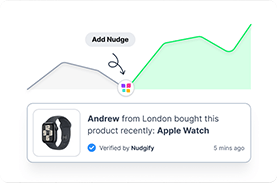
What it is. The small corner notification that says “Someone in Leeds bought the Oak Desk Lamp 12 minutes ago”. You’ve seen it on hundreds of Shopify stores. Nudgify’s sales pop is one of the apps that generates it from real order data.
Why it works. It’s a stream of tiny case studies. Each one says a real person, in a real place, made the decision you’re weighing up, and did it recently. Recency and specificity do the work.
Copy it. Connect it to your actual orders and never to a random generator. Show first name or city only, never full names. Cap the frequency so it doesn’t nag. Nudgify’s Lite plan is free, and paid plans run $9, $29 and $49 a month with a 7-day trial (see pricing).
11. Casper and quip: a plain “Best Seller” tag
What it is. On the Casper homepage, the mattress grid labels one model “The One, Best Seller”. The quip homepage does the same with a “Best seller” tag on its Ultra Lite toothbrush.
Why it works. It solves choice paralysis. A visitor facing five mattresses doesn’t want to research all five; they want to know which one most people picked. The tag answers that in two words.
Copy it. Tag your single most-ordered product in each collection. Check it quarterly so the tag stays true. One tag per collection, or it stops meaning anything.
12. Oral-B: “other customers purchased these instead”
What it is. On the Oral-B US site, an out-of-stock product shows “Sorry, this product is out of stock. Other customers purchases these instead” followed by alternatives. Amazon’s “Frequently bought together” block (example 2) is the same idea applied to add-ons.
Why it works. It’s social proof at the moment of a dead end. Instead of leaving, the visitor sees what people like them chose, which keeps them on the path to a purchase.
Copy it. On out-of-stock pages, show the two products that buyers of that item most often went for. Most ecommerce platforms have a related-products block; the trick is to base it on orders, not on what you’d like to sell.
13. Allbirds: a demand notice on the product page
What it is. The Allbirds Wool Runner page carries a banner: “Due to increased demand, orders may take up to 30 days to ship.”
Why it works. This is a warning that doubles as proof. A delay is a cost to the shopper, but the reason for the delay is that lots of other people are buying. Honest scarcity reads as popularity.
Copy it. When stock genuinely runs low, say so with the real number. A low stock nudge pulls that figure from inventory so it’s never invented. If demand delays shipping, say that too. Don’t fake either.
Expert and third-party endorsement
14. Sensodyne: “#1 dentist recommended”
What it is. The Sensodyne US homepage says “#1 DENTIST RECOMMENDED BRAND FOR SENSITIVE TEETH” with a footnote. quip (example 11) uses the softer “Dentist-recommended oral care” in its page title.
Why it works. Dentists are the people a toothpaste buyer would ask if they could. An expert endorsement borrows that trust. The footnote matters: it tells the reader the claim has a source, even if they never read it.
Copy it. Find the professional your buyer trusts (vet, physio, chef, electrician) and get one to endorse the product on the record. Name them and link to them. Never write “experts recommend” without a named expert.
15. Monzo: an independent award next to the customer count
What it is. The Monzo homepage pairs “Which? recommended 2 years in a row” with “Join 16 million people already banking with Monzo”.
Why it works. The award covers quality; the count covers popularity. Which? is a consumer body with no stake in Monzo, so the badge is a third-party opinion, not a self-assessment. Pairing it with the count closes both doubts in one line.
Copy it. Industry awards, “best of” lists from local press, and marketplace badges all count. Show the year so it doesn’t look stale, and link to the awarding body.
16. Zapier, monday.com and Stripe: logo walls and Fortune stats
What it is. Zapier heads its logo strip “Trusted by the world’s best companies”. monday.com says “Trusted by over 60% of the Fortune 500”. Stripe says “50% of Fortune 100 companies have used Stripe”.
Why it works. Logos are the fastest proof to scan; a visitor recognises a brand in a fraction of a second. The Fortune statistic adds a number to the logos so the wall doesn’t look cherry-picked.
Copy it. A small store can run a “stocked in” or “featured in” row: three local shops or two press mentions. Ask permission for each logo. If you have no logos yet, a “found in 40 independent stores” line is the text version.
17. Judge.me: platform badges on a marketplace listing
What it is. The Judge.me listing on the Shopify App Store carries a “Built for Shopify” badge (“Meets our highest standards for performance, design, and integration”) and a “2025 Build Award winner” tag. Neighbouring app cards show “4.8 out of 5 stars (4,637 total reviews)”.
Why it works. The badge is issued by the platform, so it functions like a certification. Shoppers on a marketplace trust the marketplace’s own stamp more than anything the seller writes.
Copy it. If you sell on Etsy, Amazon or eBay, earn and display the platform badges (Star Seller, Amazon’s Choice, Top Rated Seller) and then mention them on your own site: “Etsy Star Seller since 2024”.
User-generated content
18. Fenty Beauty: a hashtag invitation
What it is. The Fenty Beauty homepage has a block headed “WE WANNA SEE YOUR FENTY FACE. Share your photos with us here or tag us on the gram #FENTYBEAUTY and @FENTYBEAUTY”. YETI runs the same play with #BuiltForTheWild and a named ambassador programme.
Why it works. Customer photos are proof that real people own the product and liked it enough to post. They also show the product on bodies, in kitchens, on trails, which polished brand photography can’t do convincingly.
Copy it. Pick one hashtag, put it on the packing slip and the order confirmation email, and embed the five best posts on your product page. Ask before reposting, and credit the customer by handle.
Which format should a small store start with?
Start with the two you can source honestly today. For most stores that’s a review count with an average (example 1) and recent purchase notifications from real orders (example 10). Both run on data you already have. Add a best-seller tag per collection (example 11) in an afternoon. Everything else, the awards, the expert quotes, the logo walls, is worth building towards but takes months to earn.
One rule covers all 18: every number has to be real and traceable. The formats above work because a sceptical visitor could, in theory, check them. The moment that stops being true, the proof flips and works against you.
Frequently asked questions
What is a social proof example?
A social proof example is any visible signal on a website that other people have bought, used, rated or endorsed a product. Common formats are customer reviews, star ratings, user counts, named testimonials, live activity notifications, best-seller tags, client logos, expert endorsements and customer photos.
What is the most effective type of social proof?
Reviews and ratings are the most widely used and the easiest for shoppers to trust, because they come from many independent people. Beyond that, the most effective format is whichever answers the specific doubt your visitor has. Someone unsure about quality needs reviews; someone unsure whether anyone else buys from you needs a count or live activity.
How many reviews do you need before showing a count?
There’s no fixed threshold, but a count under about 10 can look worse than no count. Below that, show individual quoted reviews instead. Once you pass a few dozen, show the total and the average together.
Can social proof be fake?
Yes, and it’s risky. The US Federal Trade Commission finalised a rule banning fake reviews and testimonials in August 2024, and UK and EU consumer law treats them the same way. Invented reviews, random “someone just bought” generators and made-up counts are also spotted by shoppers more often than sellers expect. Every example on this page uses data from real customers or a real third party.
Where should social proof go on a product page?
Put the star rating and review count next to the price, individual reviews below the product details, and live activity notifications in a corner that doesn’t cover the add-to-cart button. Best-seller tags belong on collection pages where the choice is made.